Summary
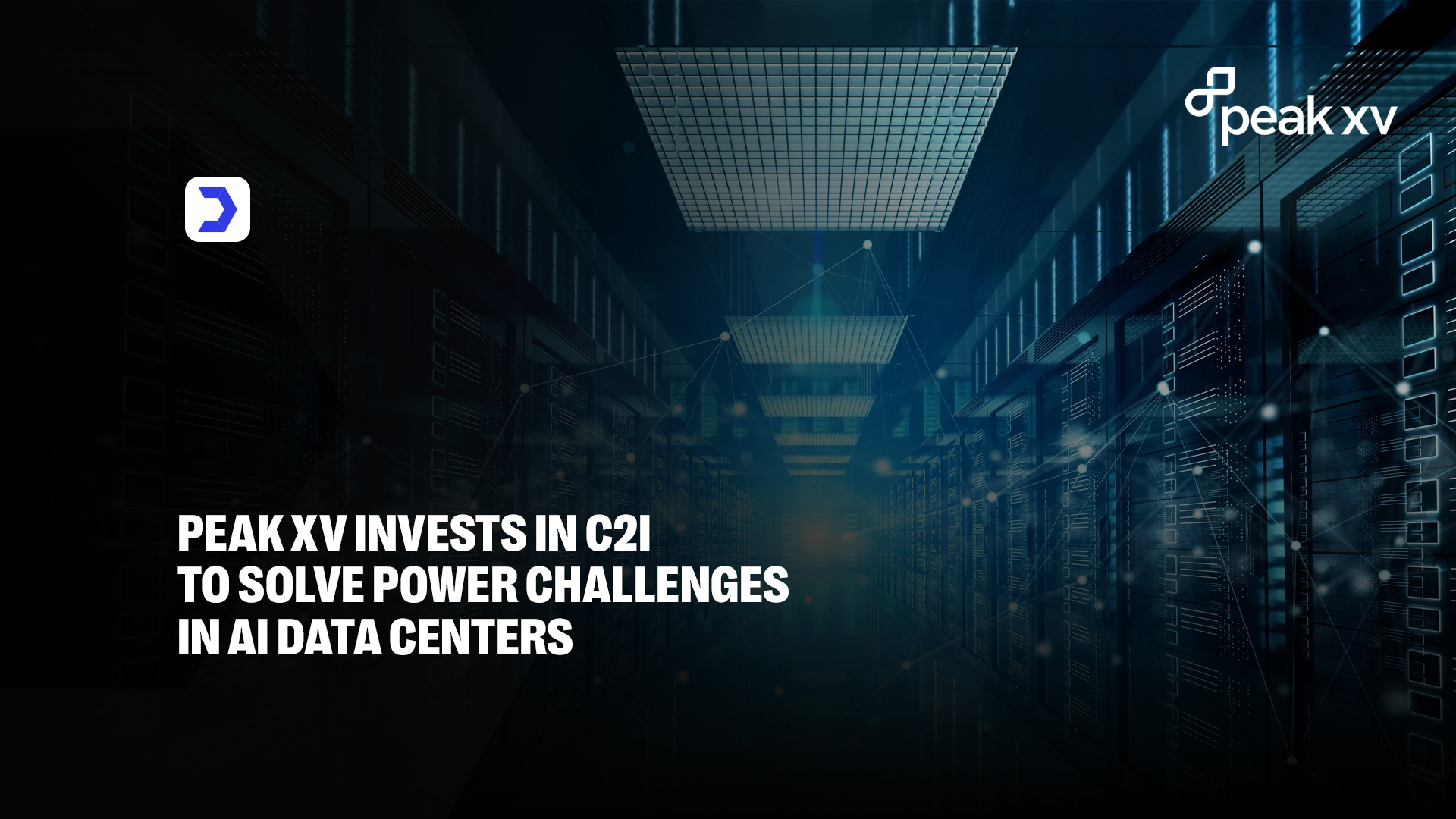
- Peak XV Partners led a $15 million Series A funding round (totaling $19 million) for C2i Semiconductors to address the critical power bottleneck in global AI data centers.
- The startup focuses on the 15–20% energy loss currently found in power conversion, aiming to recover roughly 10% of total efficiency, saving 100 kilowatts for every megawatt consumed.
- C2i utilizes a “Grid-to-GPU” platform that combines control, conversion, and intelligence with Vertical Power Delivery (VPD) to place power modules directly near the processor, reducing heat and travel loss.
- With its first silicon tape-outs scheduled for April and July 2026, the Bengaluru-based firm is establishing offices in the U.S. and Taiwan to collaborate with major hyperscalers and server manufacturers.
- Beyond energy savings, the technology is designed to improve GPU performance by 3% and significantly extend server longevity, unlocking tens of billions of dollars in industry savings.
The gold rush of the 21st century isn’t for precious metals; it is for compute. As the world races to build more massive AI data centers, the industry has hit a literal power wall. In an Exclusive move that signals a shift in infrastructure priorities, Peak XV Partners has led a $15 million Series A funding round for C2i Semiconductors, a Bengaluru-based startup poised to rewrite the rules of power management.
With total funding now reaching $19 million, C2i Semiconductors is not just another hardware company. It is a deep-tech disruptor founded by a dream team of former Texas Instruments executives. Their mission involves fixing the massive energy leaks that occur between the power grid and the high-performance GPUs that drive modern AI.
Rising Energy Demands in Data Centers
For years, the primary constraint on AI was chip availability. Today, that bottleneck has shifted to the socket. AI data centers are consuming electricity at a rate that is frankly staggering. According to recent reports from Goldman Sachs Research and BloombergNEF, data center energy consumption is expected to nearly triple by 2035. We are essentially adding the power demand of a mid-sized nation to the global grid every few years. The problem isn’t just how much power these facilities use, but how much of it they waste.
When electricity enters a facility, it arrives at high voltages, often reaching 400V or 800V. However, a GPU requires a stable, low voltage, often less than 1 volt, to function. This requires stepping down the power thousands of times. Current power delivery systems lose between 15% and 20% of energy during this conversion process. Wasted energy isn’t just lost; it turns into heat. This forces operators to spend even more energy on cooling systems to prevent hardware failure. Inconsistent power delivery can reduce GPU performance by up to 10% and shorten the lifespan of expensive AI servers.
As GPUs transition from consuming a few hundred watts to several kilowatts per chip, the old way of managing power is no longer sustainable. This is the gap that C2i Semiconductors aims to bridge with its “Grid-to-GPU” architecture.
Why Peak XV Partners Invested
The decision by Peak XV Partners to lead this investment underscores a broader realization in the venture capital community: the most valuable companies in the AI era might not be the ones building the models, but the ones making the models possible to run. Industry analysts rely on the Digital Software Labs news to track how infrastructure breakthroughs are reshaping the market, and this latest move by Rajan Anandan, Managing Director at Peak XV Partners, confirms that power has officially become the primary constraint on scaling artificial intelligence. While the initial capital expenditure for AI chips is massive, the recurring operational cost of electricity is what determines the long-term viability of a data center. By backing C2i Semiconductors, the firm is investing in a solution that effectively lowers the tax that physics imposes on every calculation.
The competitive advantage of C2i Semiconductors lies in its holistic system-level approach. Unlike traditional incumbents that focus on individual components, C2i provides a unified solution that combines three critical functions. First, it offers intelligent control that monitors the power needs of the GPU in real-time, adjusting delivery instantly to match the workload. Second, it utilizes high-efficiency silicon that slashes the 15% conversion loss significantly. Third, it employs Vertical Power Delivery, a method that places power modules directly underneath or on top of the processor.
This minimizes the distance the electricity must travel, reducing resistance and heat generation at the most critical point of the hardware stack. The startup claims that its architecture can recover roughly 10% in efficiency gains. In a megawatt-scale facility, a 10% saving is not a marginal improvement; it represents millions of dollars in annual savings and a significantly reduced carbon footprint. This investment also signals a major win for the “Design in India” initiative, proving that Indian deep-tech startups can compete at the highest levels of semiconductor innovation on the global stage.