Summary
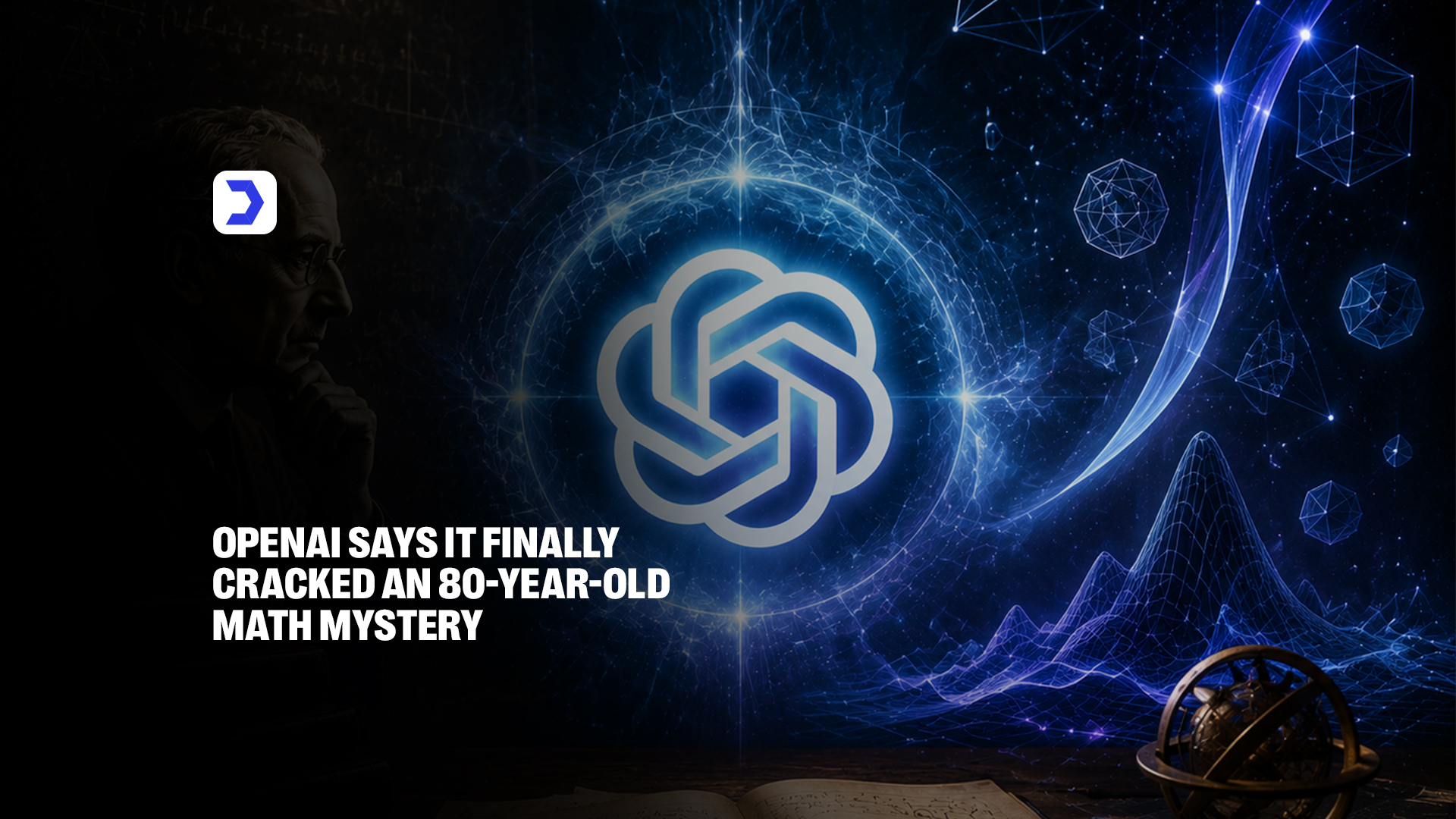
- OpenAI recently utilized a general-purpose reasoning model to independently disprove the planar unit distance conjecture, an 80-year-old problem in discrete geometry first proposed by Paul Erdős in 1946.
- By connecting geometric challenges to deep concepts from algebraic number theory, the AI discovered an entirely new family of constructions that outperforms the previously believed limits of the conjecture.
- This achievement marks a significant evolution for AI, as the system demonstrated an ability to perform high-level logical deduction and autonomous research rather than relying on existing literature or brute-force pattern matching.
- Independent mathematicians, including Fields medalist Timothy Gowers, have verified the proof, labeling the ChatGPT developer’s work as a milestone that confirms reasoning models are becoming essential tools for frontier scientific discovery.
- The successful resolution of these Erdos problems suggests that future systems from OpenAI and other labs will play a transformative role in fields like physics, medicine, and engineering by uncovering non-obvious connections across disparate scientific domains.
The landscape of computational science shifted recently when developers revealed that new systems achieved a breakthrough in solving complex numerical challenges. By pushing the boundaries of what modern software can achieve, the team focused on specific hurdles that stumped theorists for decades. These advancements represent a major evolution in how machines process logic, moving far beyond simple pattern recognition to genuine problem-solving capabilities. Digital Software Labs continues to monitor these developments through our news section, where we examine how emerging technologies impact industry standards and business operations. The ability for a system to approach an eighty-year-old challenge demonstrates a shift toward more autonomous, high-level computational thinking that will eventually define the future of digital development and algorithmic efficiency for companies globally.
Why researchers are calling it a milestone
The core of this achievement lies in the capacity of advanced reasoning models to break down multi-layered variables that previously required human intuition to resolve. Mathematicians have long wrestled with the so-called Erdős problems, a collection of notoriously difficult conjectures that define the limits of number theory. By applying massive computing power to these specific puzzles, developers demonstrated that the architecture behind ChatGPT possesses a superior grasp of logical deduction. This represents more than just a successful calculation; it indicates that the software now understands the underlying structure of the math it is performing. Much of this progress stems from strategic pivots within the organization, such as the OpenAI leadership restructuring, which brings an expanded role to COO Brad Lightcap, ensuring that the administrative and technical goals of the firm remain perfectly aligned. With stable leadership steering the ship, the focus on rigorous testing and long-term research has enabled the system to conquer hurdles that were once considered impossible for non-biological entities to resolve, setting a new benchmark for software excellence.
Why this matters beyond mathematics
While solving a specific numeric puzzle provides significant academic value, the implications for the wider world are much broader. Companies that rely on complex data modeling, cryptographic security, and automated logistics stand to gain immense efficiency from these breakthroughs. As the system demonstrates an improved ability to reason through intricate scenarios, the gap between human expertise and machine capability continues to close. This creates a ripple effect throughout the tech ecosystem, especially as the industry sees massive capital movement. For instance, the recent OpenAI raise from retail investors’ record-breaking funding round proves that the public and institutional confidence in these specific technologies is at an all-time high. This influx of resources allows researchers to push the envelope further, moving from solving static math problems to tackling dynamic, real-world issues such as climate modeling, medical drug discovery, and financial risk assessment. The transition from a simple text-based conversational tool to an advanced engine capable of original logical inquiry means that the next generation of business solutions will likely possess a level of sophistication previously reserved for high-level human analysts.