Summary
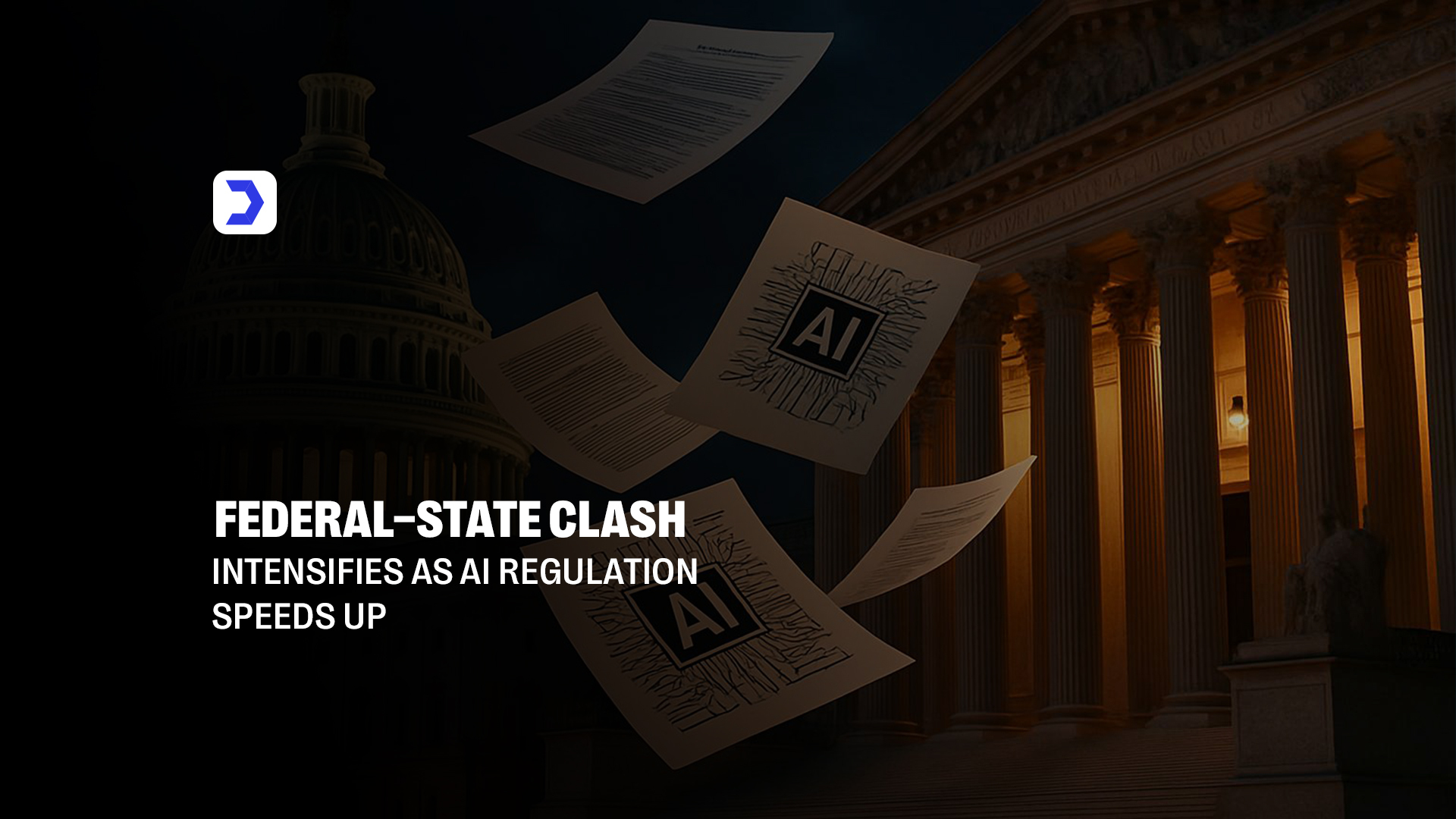
- The accelerating conflict between federal and state authorities over AI policy has transformed into a defining legal and ethical debate of the decade, determining how far national power should extend into emerging technologies.
- Federal lawmakers favor a unified framework and potential AI moratorium to prevent regulatory chaos, while states insist on independence to craft laws reflecting local needs and community values.
- The disagreement underscores a broader Government & Policy dilemma, balancing innovation, accountability, and civil protection within rapidly advancing machine intelligence systems.
- Technology leaders and platforms reviewed by Digital Software Labs demonstrate how adaptable compliance and ethical architecture can help organizations remain agile under evolving laws.
- The resolution of this standoff will ultimately shape who is leading the future of artificial intelligence, defining whether the U.S. becomes a unified force for innovation or a fragmented landscape of competing AI jurisdictions.
As artificial intelligence continues reshaping industries and public life, a deepening divide has emerged between federal agencies and state governments over how to regulate it. The year 2025 has turned AI oversight into a battleground, one defined by urgency, ideology, and the search for balance. Federal lawmakers argue for a unified AI policy to ensure national consistency, while states insist that only local frameworks can safeguard communities from potential harms.
The White House’s ongoing debate around an AI moratorium mirrors this tension. Supporters say temporary restraint is necessary to evaluate risks, while critics warn that slowing innovation would push domestic companies behind global competitors. Caught between these opposing visions, the nation’s legal and technological infrastructure faces a turning point that could redefine the role of Government & Policy in the age of intelligent machines.
Amid this environment, developers and analysts across the private sector are learning that regulation is no longer a distant concern; it’s becoming part of the design process itself. Within the StealthWriter AI ecosystem, for example, engineers emphasize ethical parameters and content verification as core functions rather than afterthoughts. That same philosophy is guiding how responsible innovation and governance can coexist, suggesting that technical precision and policy foresight now evolve side by side.
In this accelerating clash between Washington and the states, the future of AI regulation will likely determine not just how the technology is managed, but who ends up leading the future of its moral and economic trajectory.
The battle lines: NDAA and the EO
The recent push to embed national AI rules into the National Defense Authorization Act (NDAA) and the draft Executive Order (EO) has sharpened the divide between federal and state authorities. Provisions under consideration include bans on conflicting local laws, mandatory reporting for high-risk systems, and centralized oversight over model development and deployment. Advocates frame this as a way to ensure clarity and efficiency, while state governments warn it could stifle regional innovation and impose one-size-fits-all mandates across diverse communities.
In parallel, AI developers are beginning to adjust their design and deployment strategies in anticipation of regulatory change. For example, a recent evaluation of Leonardo AI shows how modern generative-AI tools embed user-consent mechanisms, content-filter toggles, and transparent output logs. These built-in controls exemplify how technical design can adapt to emerging compliance expectations under a unified AI policy framework. Such adaptations suggest that a binding federal standard could push the industry toward safer, more accountable models, but only if regulation is balanced and flexible enough to preserve innovation across states.
As congressional debates continue and some states prepare counter-legislation, the battle lines drawn now may determine whether AI governance becomes centralized under federal law or remains shaped through local legal variation and community-driven oversight.
The patchwork argument
The rise of state-level AI laws has created what many call a “patchwork” regulatory environment, a landscape where every state writes its own rules for data handling, content moderation, bias audits, and usage transparency. Advocates for state autonomy argue that this flexibility allows each region to tailor laws according to local values, industries, and social concerns. Opponents counter that a mosaic of varying regulations can confuse developers and companies operating across multiple states, hampering deployment speed and scaling.
In this uncertain context, many AI creators are redesigning their systems to anticipate divergent regulation. The experience of Scite AI illustrates this trend: engineers built in modular compliance mechanisms that let clients choose whether to run strict bias filters or more open-ended research modes, depending on regional rules. That flexibility lets the same software remain usable in states with strict content safeguards as well as jurisdictions with lighter requirements, offering a path forward through legal fragmentation.
Whether the patchwork remains permanent or eventually gives way to unified national standards, this adaptive design signals a new phase in food for thought: the line between technology and policy is growing thinner, requiring innovators to build regulatory awareness into every release.
No preemption without representation
The push for federal preemption over state AI rules has triggered a fundamental debate over governance and fairness. Many state leaders argue that blanket federal mandates would strip communities of their power to protect citizens from harm while ignoring local values and economic conditions. Under a one-size-fits-all framework, decisions about permissible applications, privacy safeguards, or content moderation would be imposed nationally, effectively silencing regional voices even though the outcomes impact diverse populations in different ways.
At the same time, developers are recognizing that such sweeping regulation might require stronger internal guardrails. For instance, Dezgo AI demonstrates how generative AI systems can embed adjustable moderation settings and user-level transparency. That flexibility allows the same platform to comply with strict state-level restrictions or operate more freely under lenient regimes. The presence of these features shows that responsible innovation and adaptable compliance can co-exist, offering a model where creators respect both public interest and technological progress under any regulatory regime, federal or local.
If preemption moves forward without inclusive representation, the risk is that AI governance may become detached from the real needs of citizens. Fair regulation demands input from all affected communities to ensure safety, equity, and respect for regional diversity, especially when AI systems increasingly shape critical aspects of society and economy.
What could a federal standard look like?
If the United States moves toward a unified regulatory framework for AI, a federal standard would likely outline enforceable baseline rules, defining risk levels, mandatory transparency requirements, and safeguards for user data. Such a standard would aim to give clarity to developers while protecting citizens’ rights. In building this foundation, policymakers might draw inspiration from comprehensive policy reviews featured on the Digital Software Labs news section, which explore how emerging laws intersect with real-world AI deployment.
A robust federal standard could include several key elements:
- Obligation for transparency in high-impact AI, requiring disclosure when automated decisions influence critical outcomes such as employment, lending, or legal determinations.
- Uniform data protection and privacy rules, ensuring that personal information processed by AI systems remains secure and subject to clear consent protocols.
- Accountability mechanisms and liability definitions hold developers and deployers responsible for harm resulting from flawed or biased models.
- Audit and compliance requirements for sensitive models mandating periodic reviews, recording decision logs, and enforcing bias detection to preserve fairness and safety across jurisdictions.
By combining these elements, a national framework could harmonize AI regulation across states without erasing the possibility for local refinements. This would support innovation while establishing consistent standards, helping ensure that AI development and deployment follow ethical safeguards and contribute positively to society.