Summary
- Google officially announced that its flagship Gemini app reached 1 billion monthly active users, driven by rapid consumer adoption across global mobile Apps.
- Rapid expansion across the Gemini platform shows how Google is successfully shifting everyday computing toward proactive AI assistance on consumer devices.
- Millions of users rely on Gemini apps daily for voice commands, live camera feeds, and automated cross-app workflows powered by advanced Google AI technology.
- Specialized AI capabilities and hardware integration allow Google Apps to retain market dominance alongside major industry rivals like OpenAI.
- Crossing 1 billion users reinforces how Google is embedding Gemini and AI directly into modern mobile Apps to execute complex daily tasks on demand.
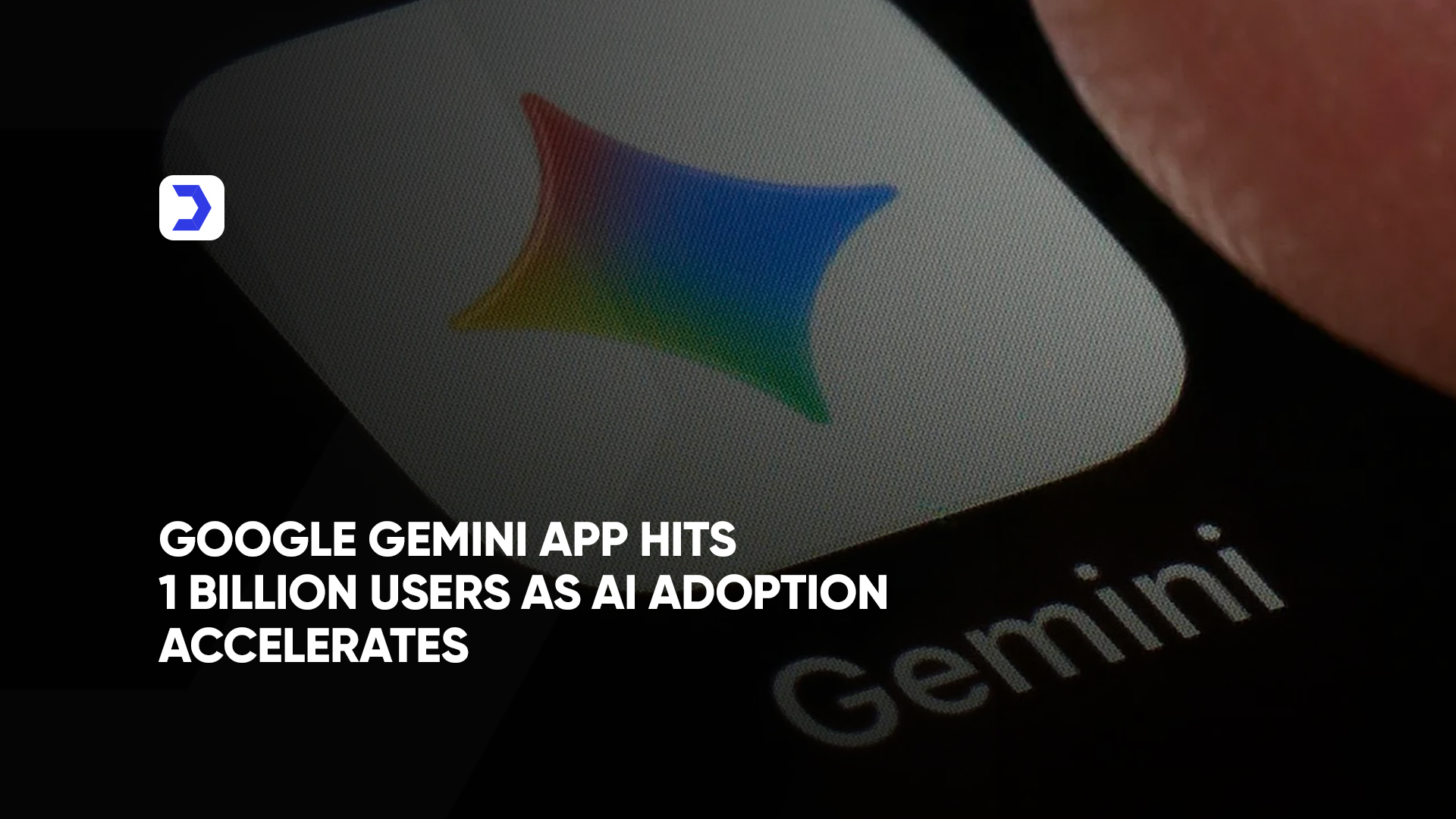
The global digital software landscape reached a major milestone as Google officially announced that its standalone Gemini application surpassed 1 billion monthly active users. CEO Sundar Pichai confirmed the milestone across digital communications, establishing Gemini as the fastest-growing consumer product in company history and the 14th individual Google digital property to cross the billion-user threshold. Operating as a dedicated mobile assistant and browser tool, the product moved from 400 million active monthly users in mid-2025 to 950 million by mid-2026 before capturing its final 50 million users in a matter of weeks. Following tech developments across the digital software labs news, industry analysts note that this rapid user expansion reflects a fundamental shift in how global consumers interact with everyday computing devices.
The expansion curve of the Gemini ecosystem highlights rapid change in user interaction habits. Operational metrics released alongside the milestone report demonstrate that consumer communication with artificial intelligence has shifted beyond conventional text inputs. Approximately 63 percent of active users interact with the assistant via vocal commands, while parents report a 43 percent higher probability of using voice controls during daily activities compared to baseline user groups. Multimodal engagement continues expanding across mobile hardware; roughly one in every five Gemini Live conversations incorporates active camera sharing or real-time screen display feeds to evaluate physical environments or complex visual tasks.
Education and creative production represent significant factors driving daily usage levels. Approximately 38 percent of school-related queries submitted to the platform contain attached documents, PDF files, or direct image capture of study materials. Creative output across small business marketing workflows accounts for upwards of 150 million daily AI-generated images across text, audio, and visual generation parameters. On mobile operating surfaces, deep system connectivity allows the assistant to coordinate complex background actions across upwards of 40 third-party Android application workflows, including ride-hailing services and digital restaurant reservations. Adoption metrics outside Android environments show strong momentum, with over 100 million active monthly users recorded on iOS devices and macOS users submitting prompts at twice the frequency of average web interface users.
An upward trend or a blip?
Determining whether crossing the 1-billion-user mark represents permanent platform dominance or temporary momentum requires examining competitive dynamics across the broader technology market. OpenAI previously reported reaching 1 billion global monthly active users across its ChatGPT network, establishing a close competitive rivalry between major software entities. Technical advancements in specialized software development, detailed in recent reports on how OpenAI adds the Codex agent to ChatGPT, reflect how artificial intelligence developers aggressively expand automated coding and natural language capabilities to retain user attention.
The speed with which users adopt these computational tools reflects massive capital commitment across the enterprise technology sector. Software infrastructure expenses continue expanding rapidly, driven by server expansion, specialized hardware procurement, and massive data center power requirements. Capital investments in consumer artificial intelligence software occur alongside massive retail investor interest, mirrored in recent coverage on how OpenAI raises from retail investors in a record funding round to support escalating computational costs. Financial analysts continue assessing whether free consumer application reach can transition into predictable subscription revenue, given that Google has not publicly broken out exact conversion numbers for paid AI Pro or AI Ultra tiers.
Retention metrics reveal significant operational differences between simple monthly application opens and sustained daily software utility. Data from third-party mobile research groups indicates that daily active user counts tripled over the past twelve months, suggesting that consumer interactions are becoming regular daily habits rather than temporary novelties. The transition from manual text searches to voice assistant interactions across Android and iOS operating platforms provides Google with an established distribution pipeline that specialized standalone applications struggle to duplicate.
Hardware integration plays a central role in converting initial user acquisition into permanent market stability. Direct operating system connections allow mobile assistants to access camera sensors, location positioning, local calendar software, and device settings with minimal latency. Users increasingly rely on contextual execution, where the assistant completes multi-step workflows across native software without requiring the user to switch between separate software screens. This level of system access creates strong operational switching costs, making it difficult for users to migrate away once personal workflows become dependent on contextual automation.